Work





Capabilities
Insights
We resolve what the brand must stand for, then build it into the world.
Start a conversationinfo@bigbrandtheory.inClarity creates » Momentum®
We resolve what the brand must stand for, then build it into the world.
Start a conversationinfo@bigbrandtheory.inClarity creates » Momentum®
When a business is not clear about what it stands for, it pays for that every single day.
Five inputs feed two engines. One aligns what the organisation already believes but has never agreed out loud. The other brings judgement accumulated across two decades of doing this. Skip either and you get a position nobody can defend in a difficult meeting.
What the organisation believes, made explicit enough to decide from. Left implicit, every team fills the gap with its own version and calls it strategy.
The accumulated judgement that comes from seeing businesses, categories and cultures change over time. Research and technology can inform it. They cannot substitute for it.
Head · Heart · Hands
Clarity has to survive contact with a customer, and that happens in three places at once. A brand leaks momentum wherever the three disagree, and the leak is almost always in the same place twice.
If this is unclear, the sales team works ten times harder than it should.
People rarely buy the specification. They buy what it says about them.
If the Head promises premium and the Hands feel cheap, momentum stops there.
A brand cannot simply be defined. Its meaning has to survive everywhere the organisation expresses and operates it. Each ecosystem has different owners and a different pace, and a brand that is precise at the core and vague at the edges is the one buyers actually meet.
Name, story, architecture, purpose, values, identity and tone of voice. Everything else inherits from here: your teams, your partners, and increasingly the AI systems generating on your behalf. It is the only part that cannot be delegated outward.
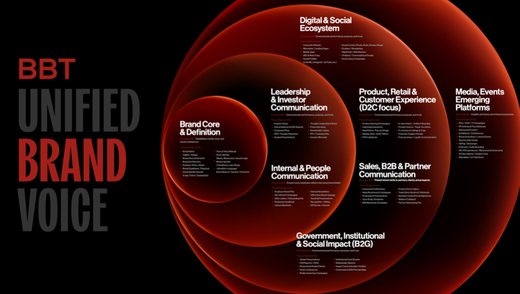
AI Every one of these is now partly produced by AI, by your teams, your partners or the systems they use. The core is what keeps the output recognisable as one brand.
The methodology does not change. What changes is the moment the business is in when we apply it, and that decides how much of the organisation has to move with the brand.
Each moment runs as one of three engagement programmes. See how we work →